 Skip to content


Manual vs. Automatic Defrost Lab Freezers: A Canadian Buyer’s Checklist
Choosing a laboratory freezer involves a practical question that is easy to miss: who will manage defrosting, and where will the contents go when maintenance is needed? For a Canadian clinic laboratory or research team, the answer belongs in the purchase decision alongside temperature range and cabinet size.
This guide compares the questions to ask about manual and automatic defrost. The two Pharmacold examples below are laboratory-storage candidates, subject to your materials’ requirements and qualification. They are not presented as a recommendation for storing frozen vaccines.
What changes with the defrost method?
Manual defrost means staff must arrange defrosting according to the equipment instructions. Automatic defrost uses an equipment-controlled process. Ask for the exact method and operating instructions for the quoted model: “automatic,” “frost-free” and “direct cooling” should not substitute for a documented description of how that freezer operates.
The useful comparison is the work your facility must do and the temperature performance it can demonstrate. Neither a defrost label nor a displayed set point establishes that every storage position stays within your materials’ permitted limits.
Start with the contents, then request performance evidence
List the required storage range for each reagent, medicine or specimen from its applicable instructions or laboratory protocol. Identify incompatible requirements before selecting a cabinet.
For drug storage within its scope, Health Canada’s GUI-0069, issued August 2020, identifies qualification considerations including empty and full loads, door openings, alarms, power loss and studies long enough to capture compressor and defrost cycles. It also calls for preventing excessive frost and using calibrated continuous monitoring at appropriate locations. Research laboratories should apply their own material-specific quality procedures; this drug guidance is not a universal rule for every research sample.
Ask the supplier for evidence relevant to your intended operating range and loading pattern, rather than treating the coldest achievable setting as proof of suitability.
Compare the operating workload before buying
| Decision point | Manual defrost | Automatic defrost |
|---|---|---|
| Maintenance responsibility | Who inspects frost and schedules the manufacturer’s defrost procedure? | Who checks the automatic system and completes the remaining maintenance? |
| Temperature evidence | What operating and restart evidence will you require? | Does the evidence include complete defrost cycles under relevant loads? |
| Temporary storage | Where will the entire affected inventory go during planned defrosting? | Where will inventory go if service or a fault requires emptying the cabinet? |
| Staffing | Can the team complete and document the planned work? | Can the team review temperature records and respond to abnormal operation? |
Request a maintenance schedule and price the staff time, monitoring and alternate storage your plan needs. Defrost type alone does not establish lower energy use or lower total ownership cost.
Two current manual-defrost Pharmacold examples
Both models were active and in stock at 360 Medical when checked on October 16, 2026. Availability can change. The linked Pharmacold specification sheets identify direct cooling and manual defrost.
| Specification | Pharmacold LAB-25R106 | Pharmacold LAB-40R308 |
|---|---|---|
| Temperature range | −25°C to −10°C | −40°C to −20°C |
| Listed cabinet capacity | 106 L | 308 L |
| Exterior W × D × H | 23.62 × 24.01 × 32.08 inches | 27.56 × 27.17 × 75.59 inches |
| Defrost / cooling | Manual / direct cooling | Manual / direct cooling |
| Published electrical supply | 115 V, 60 Hz | 115 V, 60 Hz |
For a smaller laboratory inventory: the LAB-25R106’s shorter cabinet gives a team a compact option to evaluate where floor space and inventory volume are limited. Confirm ventilation and clearance requirements before planning any under-bench installation.
For a larger or colder storage requirement: the LAB-40R308 offers a larger listed cabinet and a range extending to −40°C. Its Pharmacold sheet documents USB access to temperature and alarm records, which can support record review during routine operation and maintenance planning.
These litre figures are listed cabinet capacities, not verified usable capacity for your boxes or racks. Bring a packing list to the quotation review and check the actual storage layout. Neither model reaches ultra-low temperatures; an application requiring approximately −80°C needs a different evaluation.
Keep monitoring, maintenance and refrigeration backup separate
The product pages list alarms and controller/data-logger battery backup. That battery is not compressor power and does not establish continued refrigeration during an outage. Likewise, a remote alarm contact needs a compatible connected system and a response process to provide useful notification.
Before approving either model, identify the temporary storage location, responsible staff member and return-to-service acceptance checks. Have the equipment manual available before work begins. Use your approved procedure to decide when temperature evidence supports reloading; do not rely on a single display reading.
A separate check for pharmacies storing vaccines
Do not apply a laboratory-reagent freezer choice automatically to frozen vaccines. PHAC’s September 2026 National Vaccine Storage and Handling Guidelines address frozen-vaccine storage separately; Section 4 specifies frost-free storage or ULT storage according to the vaccine’s product monograph. Confirm the exact vaccine, equipment and provincial or territorial program requirements before purchasing. A freezer’s product title is not evidence of program acceptance.
Make the quotation answer your workflow
Send 360 Medical your required temperature range, inventory and container dimensions, room layout, electrical supply, access frequency and temporary-storage plan. Use those details to compare an appropriate cabinet and the work needed to operate it.
For related planning, read our laboratory freezer temperature-range guide and freezer alarm-response checklist.
Sources and specification checks
- Health Canada: GUI-0069, August 2020, especially Sections 2 and 5.1.
- PHAC: National Vaccine Storage and Handling Guidelines for Immunization Providers 2026, September 2026, Sections 3 and 4.
- Pharmacold LAB-25R106 specification sheet and current linked product page.
- Pharmacold LAB-40R308 specification sheet and current linked product page.
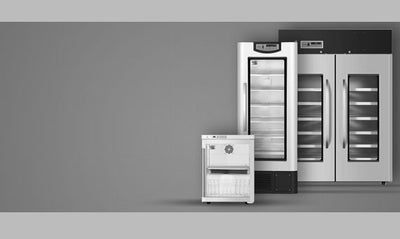
Product information and availability checked October 16, 2026. Illustration is AI-generated and depicts generic laboratory equipment, not the models compared.



Leave a comment