 Skip to content


New Vaccine Refrigerator Setup: When Can You Load Vaccines?
A new vaccine refrigerator may be plugged in and cooling, but that does not mean it is ready for inventory. Before a pharmacy or clinic loads vaccines, the cabinet needs time to stabilize, the monitoring system must be working, and staff need documented evidence that the storage area remains within the required range.
Short answer: do not load vaccines based on a single temperature reading. The Public Health Agency of Canada (PHAC) says a newly installed or newly repaired refrigerator may take 2 to 5 days to stabilize within +2°C to +8°C. The unit should have documented temperature readings before it is used, and temperatures should be watched closely after loading because adding inventory can temporarily affect cabinet conditions.
This commissioning checklist turns that guidance into a practical workflow for pharmacies, clinics and immunization providers. Always follow the refrigerator manufacturer’s instructions and your provincial, territorial or local immunization program when its requirements are more specific.
Why refrigerator commissioning matters
Vaccines are temperature-sensitive biological products. PHAC’s National Vaccine Storage and Handling Guidelines for Immunization Providers, 2026 describe the cold chain as a continuous, validated process—not simply a cabinet set to a number. A commissioning period helps confirm that the equipment, monitor, alarms, room conditions and staff response all work together before valuable inventory is put at risk.
The same principle applies after a repair that could affect temperature control. A repaired unit should not automatically return to service just because the compressor starts or the display reaches its setpoint.
1. Confirm the installation before switching on
Start with the model’s installation manual and the site plan. Confirm the electrical supply, required ventilation clearances, door swing, delivery access and ambient operating conditions. The refrigerator should be level, located away from avoidable heat sources and positioned so staff can use it without blocking airflow.
Use a dedicated, protected power connection where required by the manufacturer and site policy. Prevent accidental unplugging with an approved cord restraint or outlet notice. Record the model, serial number, installation date, service contact and warranty information in the equipment log.
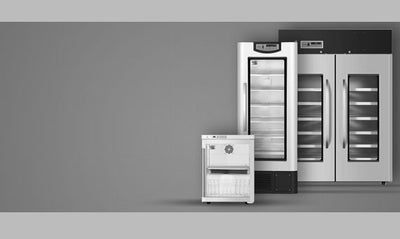
If you are still selecting equipment, compare active medical and vaccine refrigerators by temperature range, capacity, dimensions, alarms, monitoring options and electrical requirements. Choose a model that fits the inventory and workflow without crowding the shelves.
2. Install the monitoring system before inventory
Place the calibrated temperature-monitoring probe in the part of the cabinet where vaccines will be stored, following PHAC guidance, local policy and the device instructions. Monitoring the air beside a wall, vent, fan or door can produce readings that do not represent the conditions around the vaccine.
Confirm that the monitor shows the current temperature and captures the information your procedure requires. Set the correct date, time, recording interval and alarm limits. Test how data are downloaded or reviewed, and document the monitor’s calibration status.
A continuous logger and a min/max thermometer do different jobs. For a practical comparison, see Digital Data Logger vs. Min/Max Thermometer: What Vaccine Clinics Need.
3. Stabilize the empty cabinet and document the trend
For refrigerated vaccines, PHAC identifies +2°C to +8°C as the usual storage range and advises aiming for approximately +5°C to provide operating margin. A newly installed or repaired refrigerator may take 2 to 5 days to stabilize within range.
During commissioning:
- keep the door closed except for necessary setup work;
- record current, minimum and maximum temperatures at least at the beginning and end of each workday;
- review the continuous record for warm or cold excursions, cycling patterns and unexplained gaps;
- document room conditions, power interruptions, door openings and every adjustment;
- do not rely on one favourable reading or the controller display alone.
Only the designated vaccine coordinator or delegate should change the temperature setting. PHAC recommends reviewing several consecutive readings over at least 24 hours before deciding that an adjustment is necessary, because normal cycling and brief door openings can create temporary variation.
If an adjustment is needed, make a small incremental change and allow the unit several hours—typically 2 to 4 hours under PHAC’s guidance—to respond before reassessing. Repeated large changes can overshoot the acceptable range and make it harder to understand the cabinet’s actual behaviour.
4. Test alarms, notifications and the outage response
Test door, high-temperature, low-temperature and power-failure alarms that are included with the equipment. Confirm who receives after-hours notifications, how quickly they can reach the site and where the written emergency procedure is kept. An alarm with no assigned response is only a warning, not a control.
Important battery distinction: a battery that keeps a display, controller, alarm or data logger operating does not necessarily power the compressor or maintain refrigeration. Unless the manufacturer explicitly states that a battery system runs the refrigeration load—and provides compatible runtime conditions—treat it as monitoring power only.
Actual cooling during an outage requires a separately verified strategy, such as a correctly engineered UPS, a generator, a qualified alternate storage arrangement or an ice-lined or power-failure refrigerator. Review Vaccine Refrigerator Backup Power: Generator, UPS or Ice-Lined Unit? for a structured comparison.
5. Prepare the cabinet for loading
Before inventory arrives, define where each vaccine will be stored. Use clearly labelled, vented trays or bins that do not block airflow. Keep enough space between packages and cabinet surfaces for air to circulate, and retain vaccines in their original packaging to support identification and light protection.
PHAC suggests considering reloading at the beginning of a work week, when staff can observe the cabinet after the load changes. That is especially useful after a repair or when moving inventory from another unit.
6. Use a written acceptance checklist
A refrigerator is ready for service when the evidence—not the elapsed time alone—shows that the system is dependable. Your acceptance record should include:
- installation details and manufacturer-required clearances;
- model and serial number;
- temperature-monitoring device identification and calibration status;
- documented stabilization readings across the required period;
- review of the continuous temperature record;
- alarm and notification test results;
- backup-power or alternate-storage arrangements;
- the name and approval of the vaccine coordinator or delegate;
- the date and time the unit was released for use.
7. Monitor closely after loading
Loading changes the thermal behaviour of a refrigerator. Continue close temperature review after vaccines are placed in the unit, particularly during the first workday and after any major inventory change. Limit door openings, confirm the door closes fully and check that packages or trays have not blocked vents.
Continue routine checks and records required by your jurisdiction. The Canadian Immunization Guide directs providers to PHAC’s detailed storage guidance and emphasizes consulting local public health programs where requirements vary.
What if the refrigerator will not stabilize?
Do not load vaccines into an unstable unit. Check power, door closure, probe placement, airflow, room temperature and manufacturer-required clearances, then contact a qualified service technician when needed. Keep vaccines in a validated, temperature-monitored alternate unit or a properly qualified short-term transport container according to the site’s written procedure.
Commissioning is complete only when the refrigerator, monitoring system, alarms and response plan have all been verified. That documentation gives the pharmacy or clinic a defensible starting point for routine cold-chain management—and prevents “it felt cold” from becoming the acceptance test.



Leave a comment