 Skip to content


Ontario Pharmacy Vaccine Temperature Logs: 2026 UIIP Submission Checklist
Short answer: Ontario pharmacies and other Universal Influenza Immunization Program (UIIP) providers must send vaccine refrigerator temperature logs or an attestation to their local public health unit (PHU) on the schedule the PHU assigns. That schedule may be weekly, biweekly or monthly. A reliable workflow therefore needs two layers: accurate daily records and proof that the required submission was completed.

Ontario’s current UIIP guidance says organizations, pharmacies and other providers must submit temperature logs or attestations to their PHU. The PHU sets the frequency, day and submission method. It also warns that a missed submission can suspend vaccine ordering for at least one week—and longer if the record remains outstanding. This is an administrative control as well as a cold-chain task, so it deserves a named owner, a backup and a retained submission receipt.
What must be recorded each day?
Ontario’s Vaccine Storage and Handling Guidelines call for the current, minimum and maximum refrigerator temperatures to be checked and documented twice daily: once at the beginning and once at the end of the day. The log helps the PHU assess the duration and extent of a possible cold-chain exposure.
The Public Health Agency of Canada’s 2026 national guidelines reinforce that twice-daily manual review remains necessary even when a continuous data logger is installed. PHAC’s recommended record includes the current, minimum and maximum temperatures, date and time, staff initials, room temperature and relevant comments. A missed reading should remain blank rather than being reconstructed after the fact.
A practical Ontario pharmacy submission checklist
- Confirm the local rule. Record the PHU’s required submission frequency, assigned day, delivery method and contact. Do not assume that another Ontario region follows the same schedule.
- Assign a primary and backup. Give one person responsibility for the morning entry, one for the end-of-day entry and a named backup for absences. Identify who actually submits or attests.
- Capture both daily checks. Record current, minimum and maximum temperatures, date, time, initials, room temperature and comments. Reset the minimum/maximum display after the documented reading when the device requires it.
- Leave a transparent audit trail. Leave a missed reading blank. Explain corrections and unusual conditions without obscuring the original entry.
- Review weekly. PHAC recommends that the vaccine coordinator or delegate review the temperature log every week. For an automated alarm system, PHAC also says recorded data should be downloaded at least weekly while the real-time display is still checked daily.
- Submit on the PHU’s assigned schedule. Send the requested log or attestation using the approved method. Retain a confirmation email, portal receipt or other evidence of submission.
- Escalate excursions immediately. Report a reading below 2°C or above 8°C to the PHU without waiting for the next scheduled submission. Segregate affected vaccine and do not use or discard it until the PHU provides direction.
- Retain records for the required period. PHAC directs providers to follow the retention period set by their jurisdiction or PHU.
Turn the checklist into a small responsibility matrix
| Task | Suggested owner | Evidence to retain |
|---|---|---|
| Opening and closing checks | Designated shift staff | Completed temperature log |
| Weekly log review and logger download | Vaccine coordinator or delegate | Signed review and exported file |
| PHU submission or attestation | Named submitter plus backup | Email, portal receipt or confirmation |
| Out-of-range response | Staff member who discovers it, then coordinator | Incident details and PHU direction |
Where equipment features help—and where they stop
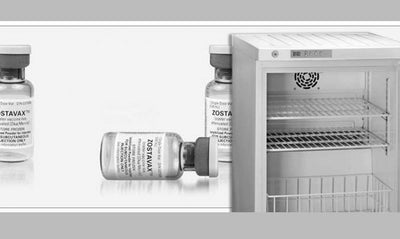
A purpose-built refrigerator can make records easier to collect, but it cannot perform the pharmacy’s review or PHU submission. The currently available Pharmacold VAX-316 upright vaccine refrigerator is one example sized for pharmacies and clinics that need an upright cabinet.
- Temperature and volume: the published range is 2°C to 8°C with a 5°C default setpoint. Its 316 L (11.2 cu. ft.) figure is the manufacturer’s chamber volume, not a promised usable vaccine capacity. Shelving plans must still leave room for airflow.
- Footprint and installation: the exterior is 23.4 × 23.4 × 75.6 in. (W × D × H). The Canadian configuration is listed at 115 V, 60 Hz, 2.5 A with a NEMA 5-15P plug and a 68 in. cord. Confirm site clearances and the manual before delivery.
- Alarms and records: documented functions include adjustable high/low temperature alarms, door-ajar and power-failure alarms, minimum/maximum display, USB PDF data export and remote alarm contacts. USB export can support weekly review, but it does not submit a file to the PHU. Remote contacts require a compatible external system; they do not by themselves send a message.
- Alarm battery: the manufacturer specifies up to 16 hours of display and alarm backup. This battery supports monitoring functions only. It does not run the compressor or maintain refrigeration during an outage.
- Refrigeration and energy: the model uses forced-air cooling, automatic defrost and R600a refrigerant. The manufacturer reports 2.5 kWh/day under its stated test conditions (25°C ambient and 5°C setpoint). Actual site consumption and savings are not established by that test value.
For other cabinet sizes, review the Pharmacold VAX refrigerator collection. For help separating a data logger from a simple min/max device, see Digital Data Logger vs. Min/Max Thermometer for a Vaccine Fridge.
Three limits to make explicit in your SOP
- Continuous logging does not replace the twice-daily review. Both Ontario and PHAC continue to call for staff checks and documentation.
- Submitting a log is not the same as reporting an excursion. Out-of-range temperatures require immediate PHU contact.
- An alarm battery is not backup refrigeration. Outage planning requires a separate, validated transfer or power strategy; do not infer cold holdover from a controller-battery specification.
Primary sources and model documents
- Ontario Ministry of Health: Universal Influenza Immunization Program (current program page, updated September 25, 2026)
- Ontario Ministry of Health: Vaccine Storage and Handling Guidelines
- Public Health Agency of Canada: National Vaccine Storage and Handling Guidelines for Immunization Providers 2026
- Manufacturer technical data sheet for the 316 L pharmacy refrigerator platform
This guide summarizes current federal and Ontario materials for operational planning. Follow the instructions of your local PHU and the storage requirements for each vaccine product.



Leave a comment